Portfolio health score
Crypto portfolio health score: one number that shows what your balance hides
Your balance tells you how much you hold. Your portfolio health score tells you whether your holdings are structurally sound or hiding critical vulnerabilities in concentration, correlation, and crash exposure that only show up when the market turns.
What a crypto portfolio health score actually measures
A crypto portfolio health score is a single composite number from 0 to 100 that evaluates the structural quality of your holdings. It does not measure returns, profit, or price performance. It measures how well your portfolio is constructed to handle risk, survive downturns, and support long-term growth.
Think of it like a credit score for your portfolio. A high balance does not mean a healthy portfolio, just like a high income does not mean a good credit score. The health score looks at how your value is distributed, how correlated your assets are, how much you would lose in a crash, and whether your allocation is intentional or accidental.
Why a single score is more useful than dashboards full of charts
Balance trackers give you prices, charts, and profit/loss numbers. But none of those answer the question that matters: is my portfolio actually healthy? A single composite score gives you an instant answer without requiring you to interpret 15 different metrics yourself.
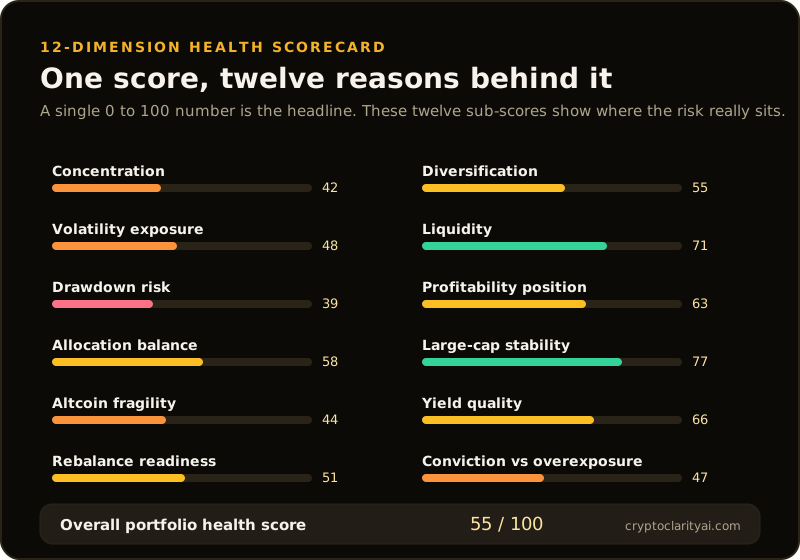
Below the top-level score, each of the 12 dimensions is scored individually. So you get both the quick answer ("my portfolio scores 41") and the detailed breakdown ("concentration is at 28, diversification is at 35, but liquidity is at 82"). The score tells you where you stand. The dimension breakdown tells you exactly what to fix.
The 12 dimensions of crypto portfolio health
Each dimension is scored from 0 to 100 based on your actual holdings. The overall health score is a weighted composite that prioritizes the dimensions with the greatest impact on portfolio resilience.
Concentration risk
How much value sits in a single asset. Scored using HHI.
Diversification
Whether holdings are spread across uncorrelated sectors.
Volatility exposure
Weighted average volatility across all positions.
Liquidity
Whether you could exit positions without major slippage.
Drawdown risk
Maximum historical peak-to-trough loss across holdings.
Profitability position
How far each holding sits from its all-time high.
Allocation balance
Whether your allocation is intentional or accidental drift.
Large-cap stability
Percentage of portfolio in established, high-cap assets.
Altcoin fragility
Exposure to small-cap coins with low liquidity and high drawdown.
Yield quality
Whether staking yield compensates for the risk of staked positions.
Rebalance readiness
How far current allocation has drifted from optimal targets.
Conviction vs overexposure
Whether large positions reflect conviction or accidental concentration.
How different portfolio types score
Your score depends on your allocation, not your balance. A $5,000 portfolio can score higher than a $500,000 one if it is better constructed.
BTC-heavy (80% BTC)
Typical weaknesses: Concentration, allocation balance, diversification
5-coin altcoin mix
Typical weaknesses: False diversification, correlation, altcoin fragility
Balanced with staking
Typical weaknesses: Yield quality, rebalance readiness
Well-diversified
Typical weaknesses: Minor drift, volatility exposure
Most crypto portfolios score between 35 and 55 because investors default to concentration and accidental allocation without realizing it.
Why your balance tells you almost nothing about portfolio health
A portfolio worth $80,000 with 88% in BTC has a higher balance than a $15,000 portfolio spread across 6 uncorrelated assets. But the $80,000 portfolio scores 36 on health because a single 25% crash wipes out $17,600 through one point of failure, while the $15,000 portfolio scores 72 because the damage is distributed and limited.
Balance trackers show both portfolios as "up" or "down" by a percentage. The health score shows that one is structurally resilient and the other is a concentrated bet masquerading as a portfolio. That distinction only matters when the market drops, which is exactly when it matters most.
From score to action: stress tests and rebalancing targets
Your health score is a diagnostic, not just a number. Each low-scoring dimension connects directly to specific actions. If concentration scores 28, the rebalancing guidance shows exactly how much to trim and where to redistribute.
If drawdown risk scores 31, the stress test shows the exact dollar damage across 4 crash scenarios. If diversification scores 35, the correlation analysis shows which holdings are falsely diversified and crash together. The score is the starting point. The detailed breakdown is the action plan.
How staking affects your portfolio health score
Staking adds passive yield, but it does not automatically improve your health score. The Yield Quality dimension evaluates whether staking APY compensates for the risk profile of the staked asset. Earning 3% on ETH scores differently than earning 15% on a small-cap altcoin that is down 70% from ATH.
Staking-aware projections also factor yield into future value calculations. A staked position compounding at 12% APY has a meaningfully different 5-year outlook than the same position without staking, and the health score reflects this in the overall portfolio assessment.
Get your health score
Score your crypto portfolio across 12 risk dimensions in 60 seconds
Enter your holdings, mark staked positions with APY, and get a full health score with individual dimension breakdowns, stress tests, concentration scoring, and rebalancing and allocation risk checks targets. $12 one-time, regularly $19. No wallet. No account.
Crypto portfolio health score FAQ
What is a crypto portfolio health score?
A crypto portfolio health score is a single number from 0 to 100 that measures the structural quality of your holdings across multiple risk dimensions. Unlike your balance, which only shows what you own, the health score evaluates how your portfolio is constructed: concentration, correlation, volatility, drawdown exposure, allocation balance, and more.
How is the score calculated?
The score is a weighted composite of 12 individual dimension scores. Each dimension is scored from 0 to 100 based on your actual holdings. The overall score combines these with weights that reflect their impact on long-term portfolio resilience. Concentration risk and diversification carry the highest weight because they determine how a crash affects your entire portfolio.
What is a good crypto portfolio health score?
Above 70 is structurally sound. 50-70 has significant issues worth addressing. Below 50 has critical vulnerabilities that could cause outsized losses in a downturn. Most portfolios score between 35 and 55 because investors default to concentration and accidental allocation.
How is this different from portfolio returns or profit/loss?
Returns tell you what happened in the past. Your health score tells you how resilient your portfolio is going forward. A portfolio that returned 200% last year can still score 32 if it is 85% concentrated in one coin with high correlation across the rest. Past returns do not predict structural risk.
Can I improve my score without selling my largest position?
Sometimes. If your score is low mainly due to allocation drift or missing low-correlation assets, adding new positions can improve it. But if concentration is above 70%, some trimming is usually necessary. The rebalancing guidance shows exact targets across three strategy modes so you can choose the approach that fits your conviction level.
Does the score account for staking?
Yes. If you mark holdings as staked with APY, the Yield Quality dimension scores whether your staking yield compensates for the risk of those staked positions. Staking at 3% on a coin that is down 70% from ATH scores differently than staking at 15% on a stable large-cap.
How much does Crypto Clarity AI cost?
$12 one-time, regularly $19. No recurring plan, no monthly fees. You get the full 12-dimension portfolio health score, stress tests across 4 crash scenarios, rebalancing and allocation risk checks, staking-aware projections, and 2 bonus spreadsheets. existing 7-day refund policy.
Related tools and reading
Feature
Crypto concentration risk explained
Feature
Rebalance with exact dollar targets
Feature
Crypto stress test simulator
Tool
Crypto diversification calculator
Tool
Crypto future value calculator
Article
What is a healthy crypto portfolio allocation
Article
What most crypto trackers miss about portfolio health
Reference
The 12 dimensions of portfolio health