Crypto concentration risk
Crypto concentration risk: why one coin can wreck your entire portfolio
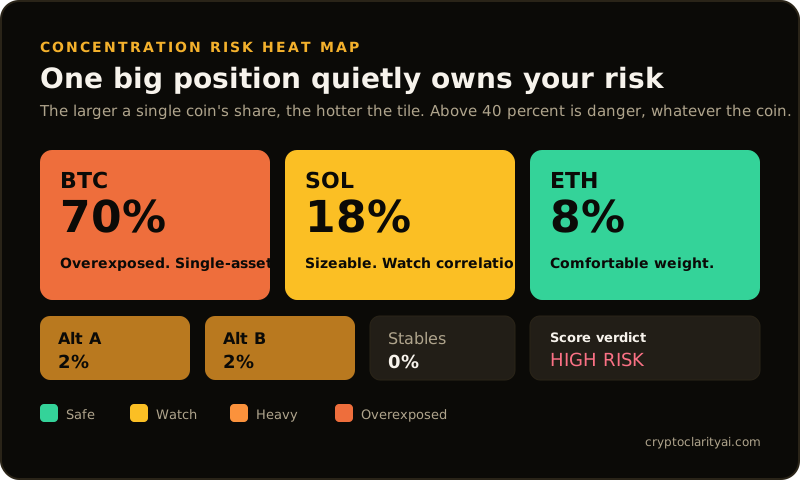
Most crypto portfolios have a single point of failure and the investor does not know it. Concentration risk is the structural weakness that turns a normal correction into a portfolio-level disaster. If more than 50% of your value sits in one asset, you are not investing. You are making a used bet with extra steps.
What crypto concentration risk actually is
Concentration risk is the danger of having too much portfolio value in a single asset. When that asset drops, your entire portfolio takes a disproportionate hit because one position dominates everything else.
In traditional finance, concentration risk is one of the most studied portfolio dangers. Fund managers are required to measure it, report it, and limit it. In crypto, where individual coins routinely move 20-50% in days, concentration risk is amplified dramatically. Yet most crypto investors never measure it at all.
A portfolio with 80% in BTC does not lose 40% when BTC drops 50%. It loses the equivalent of 40% of total value from a single holding, plus whatever damage the remaining 20% takes. The math is simple, but almost no one runs it until after the crash.
Why concentration risk is so common in crypto
Most crypto portfolios start with conviction in one or two coins. You buy BTC because it is the safest bet. You add ETH because it seems like the natural second choice. Maybe you add a few altcoins. Over time, the portfolio drifts: BTC outperforms and grows from 50% to 75% of total value without a single trade.
This is allocation drift, and it is the most common source of concentration risk. The investor never intended to be 75% in BTC, but price movements silently restructured the portfolio. By the time a correction hits, the concentration is far higher than it was at purchase.
Standard crypto trackers show you a pie chart of your allocation, but they never flag that your allocation is dangerous. They never calculate the structural health of how that allocation distributes risk.
How to measure concentration risk: HHI scoring
The Herfindahl-Hirschman Index (HHI) is the standard metric for measuring portfolio concentration. It squares the allocation percentage of each holding and sums the results. A single-asset portfolio scores 10,000. Below 1,500 is considered well-diversified.
Extreme concentration
90% BTC portfolio
HHI score: 8,100
Single-asset failure point. A 50% BTC drop costs 45% of total portfolio.
High concentration
70% BTC + 30% ETH
HHI score: 5,800
Two correlated assets. Both drop in the same crash, offering no real hedge.
Moderate concentration
5 coins, largest is 40%
HHI score: 2,600
Better spread, but top position still drives most of the drawdown.
Low concentration
8 coins, none above 20%
HHI score: 1,250
No single holding dominates. Crash damage is distributed across positions.
Crypto Clarity AI calculates HHI automatically alongside 11 other risk dimensions. You do not need to compute this manually.
Why BTC-heavy portfolios underestimate concentration risk
BTC-heavy portfolios are the most common allocation in crypto. Investors hold 60-90% BTC because it feels like the safest choice. And in terms of volatility, BTC is less volatile than most altcoins. But concentration risk is not about volatility. It is about allocation structure.
An 85% BTC portfolio with $48,000 total value has $40,800 in a single asset. If BTC drops 40%, the portfolio loses $16,320 before considering what happens to the remaining 15%. The investor chose BTC for safety, but the allocation structure created a massive single point of failure.
The common defense is "BTC always recovers." Even if that is true, a 50% drawdown requires a 100% recovery to break even. If your portfolio drops from $48,000 to $26,000, you need BTC to double just to get back to where you were. A less concentrated portfolio takes less damage and recovers faster.
False diversification: when spreading out does not reduce risk
Concentration risk does not only mean holding one coin. It also means holding multiple coins that behave like one coin. This is false diversification: the portfolio looks spread out but crashes as a single unit because every holding is highly correlated.
Holding BTC, ETH, SOL, AVAX, and MATIC across five "different" positions feels diversified. But in a market crash, these assets tend to drop 35-60% in the same week because they share the same market cycle, the same investor base, and the same risk sentiment. Your 5-coin portfolio has an HHI suggesting moderate concentration, but the correlation-adjusted risk is much higher.
Signs your diversification is not real:
- You hold 5+ coins but they all dropped 40%+ in the same week
- Your top 2 positions make up over 65% of total value
- Every holding is a Layer 1 smart contract platform
- Your portfolio went up 3x and down 3x in perfect sync with BTC
- You added coins for diversification but never checked correlation
How concentration amplifies crash damage
A stress test on a concentrated portfolio reveals a multiplier effect. When one holding dominates your allocation, a crash does not spread the damage across positions. It channels most of the loss through that single holding.
Example: two portfolios, both worth $40,000. Portfolio A holds 85% BTC and 15% in 3 altcoins. Portfolio B holds 25% BTC, 20% ETH, and the rest across 5 uncorrelated assets. In a 50% BTC correction where altcoins drop 60%:
Portfolio A (concentrated)
-$20,600
51.5% total loss. BTC alone costs $17,000.
Portfolio B (diversified)
-$14,800
37% total loss. Damage spread across positions.
Same starting value. Same crash. $5,800 difference in damage. That is the cost of concentration risk, and it compounds in every subsequent downturn.
How to reduce concentration risk through rebalancing
Reducing concentration risk does not mean selling your winners or abandoning conviction. It means understanding the structural cost of your current allocation and deciding whether that cost is worth it.
Rebalancing targets specific allocation changes to bring HHI into a safer range. Common approaches include:
- Trim the dominant position by 10-20%. Reducing an 80% BTC position to 60% cuts HHI from 6,800 to 4,400.
- Add low-correlation assets. Positions that do not move in lockstep with BTC reduce portfolio-level crash damage.
- Set allocation caps. No single position above 40%. No top 2 positions above 60% combined.
The 12D framework provides exact dollar amounts for rebalancing across three strategy modes: BTC Core, Balanced, and Aggressive Diversification. Each shows what to buy, what to trim, and by exactly how much.
Measure your concentration risk now
See exactly which positions are creating outsized risk in your portfolio
Enter your holdings and get concentration risk scoring, HHI calculation, stress tests across 4 crash scenarios, and rebalancing and allocation risk checks in under 60 seconds. $12 one-time, regularly $19. No wallet. No account.
Crypto concentration risk FAQ
What is crypto concentration risk?
Crypto concentration risk is the danger of having too much of your portfolio in a single asset or a small group of highly correlated assets. If that asset drops, your entire portfolio takes a disproportionate hit. A portfolio with 80% in BTC loses 40% of total value from a single 50% BTC correction.
How do I measure concentration risk?
The standard measure is the Herfindahl-Hirschman Index (HHI). It squares the percentage allocation of each holding and sums the results. A perfectly concentrated (single-asset) portfolio scores 10,000. Below 1,500 is considered well-diversified. Crypto Clarity AI calculates HHI automatically alongside 11 other risk dimensions.
Is a BTC-heavy portfolio always high risk?
Not always, but it is always concentrated. BTC is less volatile than most altcoins, but concentration risk is about allocation structure, not asset quality. An 85% BTC portfolio has a structural single point of failure regardless of how stable BTC is compared to other coins. The question is whether that concentration is an intentional conviction bet or accidental drift.
What is false diversification?
False diversification is when your portfolio looks spread across multiple coins but those coins are highly correlated. Holding BTC, ETH, SOL, AVAX, and MATIC feels diversified, but in a crash they tend to drop together because they share the same market cycle and investor base. True diversification requires low correlation between holdings.
How do I reduce concentration risk without selling everything?
You do not need to sell everything. Common approaches include trimming the largest position by 10-20%, adding uncorrelated assets to reduce HHI, and setting target allocation caps. Crypto Clarity AI provides exact dollar rebalancing amounts across three strategy modes so you can choose the approach that matches your conviction level.
Does concentration risk change over time?
Yes. Even if you start with balanced allocations, price movements cause drift. If BTC doubles while your altcoins stay flat, your BTC allocation grows from 40% to 57% without any trades. This is called allocation drift, and it silently increases concentration risk. Periodic measurement catches this before it becomes dangerous.
How much does Crypto Clarity AI cost?
$12 one-time, regularly $19. No recurring plan, no monthly fees. You get the full 12-dimension portfolio health score including concentration risk scoring, stress tests across 4 crash scenarios, rebalancing and allocation risk checks, staking-aware projections, and 2 bonus spreadsheets. existing 7-day refund policy.
Related tools and reading
Feature
Crypto portfolio health score
Feature
Rebalance with exact dollar targets
Tool
Crypto diversification calculator
Article
How to know if your crypto portfolio is too concentrated
Article
Why most crypto portfolios are not actually diversified
Article
BTC-heavy portfolio risk analysis
Profile
BTC-heavy portfolio breakdown
Reference
The 12 dimensions of portfolio health