Blog
How to stress-test a crypto portfolio for a 2018-style crash
By the founder · Updated 2026-07-31
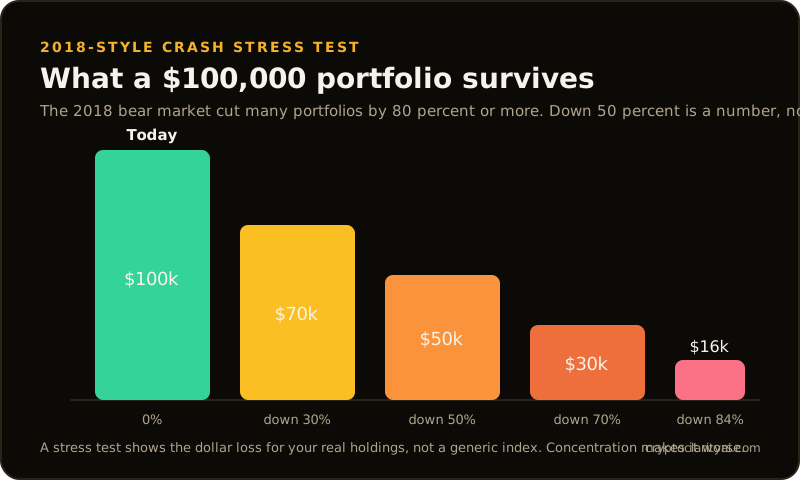
A stress test answers one question: if a 2018-style crypto winter happened again next month, what would your portfolio actually look like, in dollars, not percentages? This guide walks through the exact crash scenarios that matter (2018 winter, 2022 unwind, BTC -50% / -75% / -90%), how concentration and correlation make the damage worse, and how to run the numbers on your own holdings before the market does it for you.
Why stress testing matters
Every crypto investor has a plan until the market drops 40% in a week. The problem is not the drop itself. It is not knowing how bad the damage will be until it is already happening.
Stress testing means running your current portfolio through realistic crash scenarios before they happen. Banks do this. Hedge funds do this. Individual crypto investors almost never do.
What a stress test actually looks like
A proper stress test takes your exact holdings and models what would happen under different conditions:
- Moderate correction (20% drop): How much do you lose in dollar terms? Which positions get hit hardest?
- Major crash (40% drop): Does your portfolio survive? Are you still comfortable with the remaining value?
- Prolonged bear market: What if prices stay down for 12 months? Which coins have the fundamentals to recover?
The concentration problem
Stress tests reveal a problem that feels invisible during bull markets: concentration risk. If 60% of your portfolio is in one coin, a 40% market drop does not hit you at 40%. It hits your entire financial position through that single point of failure.
This is why investors who look diversified on paper can still lose disproportionately during downturns. Their diversification was an illusion.
How to run your own stress test
You can do a basic version manually:
- List every holding with its current value
- Multiply each by 0.6 (simulating a 40% drop)
- Look at the total and ask if you are comfortable with that number
- Check which positions lost the most in absolute dollar terms
The manual approach works but misses correlation effects. When BTC drops, most altcoins drop harder. A real stress test accounts for how different assets respond to the same market event.
What to do with the results
The point of a stress test is not to scare yourself. It is to identify the positions and allocations that create outsized downside risk so you can adjust before you need to.
Common actions after a stress test include reducing oversized positions, cutting coins with no recovery potential, and rebalancing toward a healthier allocation.
Automated stress testing with Crypto Clarity AI
Crypto Clarity AI runs four stress test scenarios automatically against your actual holdings: -20% (correction), -50% (major crash), -75% (prolonged bear), and -90% (worst case). For each scenario, it shows:
- Exact dollar loss per holding, not just percentages
- Which positions contribute most to total drawdown
- Your portfolio health score under stress
- Whether your diversification actually protects you
It also checks concentration risk, which is the single biggest factor in crash damage. If 60% of your portfolio is in one coin, no amount of diversification in the other 40% saves you.
When to stress test
Run a stress test whenever:
- You add a new coin or significantly change your allocation
- A single holding grows past 40% of your portfolio
- Market sentiment shifts (check the Fear and Greed Index)
- You have not reviewed your portfolio structure in 30+ days
Now you know how stress testing works, how does your own portfolio hold up?
Enter your holdings in Crypto Clarity AI and see exact dollar losses across 4 crash scenarios, plus your 12D health score under stress, in 60 seconds.
One-time $12 launch price (regularly $19). No wallet, no account, no upload. 7-day money-back guarantee.
Read next