How to Rebalance a Crypto Portfolio (Step-by-Step, 2026)
By the founder · Published 2026-07-05
How to rebalance a crypto portfolio, step by step: build one book, score your risk, set targets, measure drift, and trim in stages. Free, no wallet connection.
Rebalancing a crypto portfolio means bringing each position back to the weight you chose on purpose, by trimming what grew too big and topping up what lagged. The reliable way to do it is a simple loop: put every holding into one book, score your current risk, set targets by risk instead of vibes, measure each coin's drift, then move in small steps and re-score to confirm the risk actually dropped. This guide walks the exact procedure, with real dollar numbers so you can copy it.
Step 1: Put every holding into one book
Your true allocation is the whole book, not one app's slice of it. Coins scattered across a hardware wallet, two exchanges, and a staking account can each look reasonable alone while adding up to something lopsided. So the first move is boring and essential: list every asset and its current dollar value in a single place.
You only need the asset, how much you hold, and roughly what it is worth today. That is enough to compute weights and drift. No wallet-connect, no seed phrase, no API key, ever. If any tool asks to connect to check your balances, close the tab.
Step 2: Score your current risk before you touch anything
Rebalancing without a starting read is just moving money and hoping. Before you trade, get a baseline so you know what you are fixing. A crypto portfolio health score collapses concentration, correlation, drawdown exposure, and eight more dimensions into a single 0 to 100 number with a plain-language label. You can run that baseline free, with no signup and no wallet connection, in the live demo.
Write the number down. If the score is already healthy, you may not need to trade at all. If it is low, the score tells you which risk is driving it, usually concentration, so you rebalance toward the thing that actually moves your number.
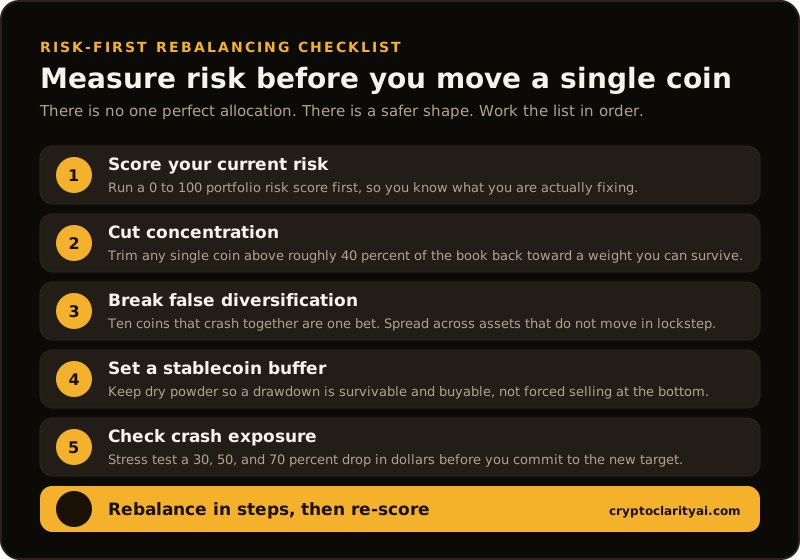
Step 3: Set target weights based on risk, not vibes
A target is the weight you want each position to hold. Pick targets from how much risk each asset carries, not from which coin feels exciting this month. Large-caps can carry a bigger share than speculative small-caps because they are less fragile. A stablecoin sleeve is your shock absorber. The point is that you decide the weights on a calm day, in writing, so the market cannot decide them for you later.
If you want a framework for choosing those weights rather than the mechanics, our companion piece on crypto rebalancing strategy for 2026 covers the philosophy. This post stays on the how.
Step 4: Measure each position's drift from target
Drift is the gap between where a position sits now and where you wanted it. Take each coin's current weight, subtract its target, and you have its drift in percentage points. Anything more than about 5 to 10 points off is a candidate to fix. A crypto portfolio rebalancing calculator does this arithmetic for you and turns "I feel off target" into exact dollar amounts.
Here is a worked example. Suppose you have a $40,000 book:
- SOL: $22,000, which is 55 percent
- BTC: $10,000, which is 25 percent
- ETH: $4,000, which is 10 percent
- USDC: $4,000, which is 10 percent
One coin at 55 percent is the whole story here, and a concentration calculator would flag it immediately. Say your risk-based targets are BTC 35 percent, ETH 20 percent, SOL 30 percent, and stablecoins 15 percent. In dollars that is BTC $14,000, ETH $8,000, SOL $12,000, USDC $6,000. The drift falls out cleanly: SOL is $10,000 over target, BTC is $4,000 under, ETH is $4,000 under, and USDC is $2,000 under.
Step 5: Decide what to trim and what to add
The trades write themselves once you have drift in dollars. In the example, you trim $10,000 of SOL and redeploy it: $4,000 into BTC, $4,000 into ETH, and $2,000 into your stablecoin sleeve. That single sequence takes SOL from a 55 percent bet down to your chosen 30 percent, and it does it by feeding the positions you deliberately kept under-weight.
Trim from what dominates your downside first. The oversized position is both your biggest drift and your biggest risk, so fixing it buys the most improvement per trade. You do not have to touch coins that are already close to target.
Step 6: Remember that selling can have tax consequences
Trimming a winner can create a taxable event if the position is in gain, and the rules depend on where you live and how long you have held. Before you sell a large slice, it is worth checking how the trade lands for your situation, and a qualified tax professional can tell you whether a shorter or longer holding period changes the outcome. Sometimes pairing a trim with a lagging position you are willing to exit can offset gains. This is educational information about portfolio structure, not financial advice.
Step 7: Move in steps, not all at once
You do not have to place the whole trade in one click. Selling $10,000 of SOL in three or four tranches over a couple of weeks smooths out the price you get and keeps a single bad day from defining the whole rebalance. Staged moves also give you room to reassess if the market shifts sharply mid-plan. The goal is to reach your target weights, not to time the exact top.
If you want to see how the downside looks before and after you move, a crypto stress test shows what a 30, 50, or 70 percent drop does to the book in each state, which makes the case for trimming concrete rather than abstract.
Step 8: Re-score to confirm the risk actually dropped
This is the step most people skip, and it is the one that proves the work. Re-run the same score on your new weights. In the example, SOL falling from 55 percent to 30 percent should visibly relax the concentration flag and lift the overall number, say from a shaky low read into a healthier band. If the score barely moves, your targets were too timid or you trimmed the wrong position, and you now know to adjust.
Turning the loop into a repeatable habit
Rebalancing is not a one-time cleanup. Markets keep moving, so drift keeps returning, and the calm fix is to re-run this loop on a schedule or whenever a position crosses your drift band. Because you enter holdings by hand, you can re-run it any time your book changes, with no subscription. For a look at what a purpose-built view should surface at each step, see what a crypto rebalancing tool should show.
The free demo gives you the baseline score and headline read. The one-time $19 $12 unlock opens your full per-position drift, the prioritized trades ranked by how much they cut risk, and the before-and-after on all 12 dimensions, for lifetime access. Either way, the order is what matters: measure, target, trim in steps, then measure again. Run your baseline now in the demo and you will know exactly what to rebalance before you place a single trade.
Frequently asked questions
- How do I rebalance my crypto portfolio?
- List every holding across all wallets and exchanges in one book, score your current risk, set target weights based on risk, measure each position's drift from target, trim what grew too big and top up what lagged, move in small steps, then re-score to confirm the risk actually dropped. No wallet connection is needed because you enter holdings by hand.
- How often should I rebalance a crypto portfolio?
- Many long-term holders rebalance on a schedule such as quarterly, or whenever a position drifts more than a set band like 5 to 10 points from its target. Rebalancing constantly racks up fees and taxable events, while never rebalancing lets a winner quietly become concentration risk.
- Does rebalancing reduce risk?
- Yes. Trimming an oversized position and topping up under-weight ones keeps concentration and correlation in check, which is exactly what a risk score measures. Re-score before and after so you can see the change instead of guessing.
- Do I have to sell everything to rebalance?
- No. You only trim the slice that grew past its target and redeploy it into the under-weight positions. Most rebalances touch one or two coins, not the whole book.
- How much does it cost?
- The demo and score are free. A one-time 19 dollars unlocks the full 12-dimension breakdown, every risk flag, and a fix-it plan for lifetime access. It is not a subscription.
Score your portfolio first so you know exactly what to rebalance.
Free portfolio health score across 12 dimensions. No signup. Real fund-style math on your holdings.
