Bitcoin Allocation Risk
How much Bitcoin is too much, or too little? Check your real BTC allocation risk across concentration, correlation, and drawdown in about 60 seconds. Free, no wallet connection.
How much Bitcoin belongs in your portfolio is one of the most argued questions in crypto, and both extremes are usually wrong. Too little, and you carry all the volatility of alts without the anchor. Too much, and one asset decides your entire outcome. Crypto Clarity AI shows your real Bitcoin allocation risk in about 60 seconds, free, with no wallet connection.
The short answer
For most long-term holders, a 40 to 60 percent Bitcoin core is a defensible starting range. Under 30 percent BTC in a crypto-only portfolio is an active bet that something else outperforms, and you should be able to defend that bet in one sentence. Over 70 percent is fine if you are treating crypto as a savings vehicle rather than trying to compound through alts.
But the right number is not static, and the headline percentage hides two things: your effective exposure and your concentration risk. The tool surfaces both.
Two numbers most holders never check
Effective BTC exposure. Your spot balance is not the whole story. Wrapped BTC, and assets that move almost in lockstep with Bitcoin, add to your real exposure. Many people are more concentrated in Bitcoin than their spot number shows.
Single-asset concentration. A high BTC weight lowers altcoin risk but raises the odds that one drawdown hits nearly everything you own. Bitcoin is the most forgiving place to be concentrated because of its liquidity and recovery record, but it is still concentration.
Worked examples
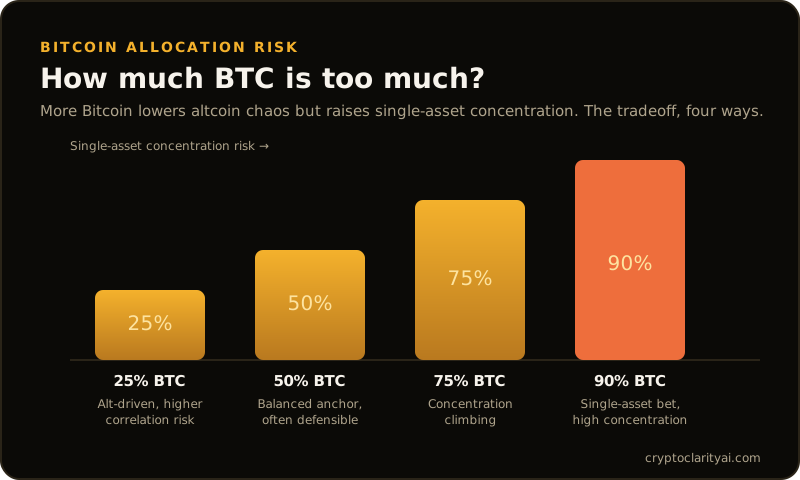
The point of these four is that the same BTC percentage can be safe or dangerous depending on what surrounds it. The number is not the answer; your total portfolio risk is.
25 percent Bitcoin. Say 25 percent BTC, 10 percent ETH, and 65 percent across a spread of altcoins with no stablecoins. This portfolio has no real anchor. When the market turns, the alts fall hard and a thin Bitcoin core is not enough to steady it. Here 25 percent reads as high risk, because the rest of the book is fragile. The tool flags low core allocation and high altcoin concentration together. The same 25 percent BTC alongside a large stablecoin buffer and two liquid majors would score very differently.
50 percent Bitcoin. Suppose 50 percent BTC, 20 percent ETH, 15 percent SOL, 15 percent stablecoins. A liquid Bitcoin core, a second major with a different driver, one satellite, and dry powder. This is the shape that tends to score well on allocation risk, because the BTC weight is doing real work against a spread of supporting positions rather than sitting next to a pile of thin small caps.
75 percent Bitcoin. Say 75 percent BTC, 10 percent ETH, 15 percent stablecoins. Altcoin risk is low and there is a cash buffer, so this is a defensible savings-style shape. The main thing the tool surfaces is single-asset concentration: at 75 percent, one deep BTC drawdown moves nearly the whole book, so the 15 percent buffer is what keeps the risk read reasonable.
90 percent Bitcoin. Suppose 90 percent BTC, 10 percent one altcoin, no stablecoins. Altcoin risk is minimal, but everything rides on one asset with no cash to buy a dip or cushion a drawdown. Whether that is right depends entirely on your horizon and whether you want dry powder; the tool flags the missing buffer rather than the BTC weight itself.
Hidden over-exposure. Say 40 percent spot BTC plus 20 percent in wrapped BTC and BTC-correlated assets. It reads as 40 percent Bitcoin, but effective exposure is closer to 60 percent. The tool shows the true figure so you are not surprised by it, and this is why a fixed target percentage can mislead you about your real allocation.
How Crypto Clarity AI evaluates it
Bitcoin allocation risk is scored as part of the full 12-dimension model, so your BTC weight is judged in context: against your correlation profile, your stablecoin buffer, and your drawdown sensitivity, not as a number in isolation. That is why the same 60 percent BTC weight can score well in one portfolio and poorly in another.
What your free analysis shows
The free demo shows your current BTC percentage and headline allocation read. The full report opens (free, sponsor-supported): your effective BTC exposure, your concentration and correlation maps, drawdown sensitivity, and a prioritized plan to move toward a target allocation. Free to use, supported by clearly labeled sponsors.
Related pages
Frequently asked questions
- How much Bitcoin should I hold in my crypto portfolio?
- For most long-term holders with no strong edge in altcoins, a 40 to 60 percent BTC core is a defensible range. Shift higher near cycle tops for defense and lower mid-cycle only if you have a clear rotation thesis. The tool shows your current BTC percentage and how it affects your risk score.
- Is too much Bitcoin risky?
- A very high BTC weight lowers altcoin-specific risk but raises single-asset concentration, so a deep drawdown in BTC hits almost your whole portfolio. It is generally lower risk than the same weight in an altcoin because of BTC liquidity and recovery history, but it is still concentration, and a stablecoin buffer helps.
- What is effective Bitcoin exposure?
- Your effective BTC exposure includes wrapped BTC and any assets pegged to or heavily correlated with Bitcoin, not just spot BTC. Many holders are more exposed to Bitcoin than their spot balance suggests. The tool estimates your true effective exposure.
- Is holding 100 percent Bitcoin a good idea?
- It removes altcoin risk entirely and is a reasonable savings-style approach for some holders, but it concentrates everything in one asset and one drawdown profile with no dry powder to buy dips. Whether that is right depends on your horizon and whether you want a cash buffer.
- How do I find my real Bitcoin allocation?
- Most holders know their dollar amount, not their percentage. Enter your holdings and the tool shows your current BTC percentage at today prices, your effective BTC exposure, and how far you have drifted from a target allocation.
Check your real Bitcoin allocation risk in about 60 seconds.
Score your portfolio across all 12 dimensions in about 60 seconds. The full breakdown, every risk flag, and your fix-it plan are free to use, supported by clearly labeled sponsors. Prefer no ads? lifetime access removes them all.
No wallet connection. No exchange login. free risk check available. Lifetime access unlocks the complete report.
Crypto Clarity AI is an educational risk-analysis tool, not financial advice. Nothing on this page is a recommendation to buy, sell, or hold any asset. Crypto is highly volatile and you can lose money. Figures shown are illustrative examples, not predictions. Always do your own research.
