Crypto Portfolio Rebalancing Strategy for 2026
By the founder · Published 2026-07-05
A risk-first crypto rebalancing strategy for 2026: concentration caps, threshold triggers, and a stablecoin buffer. Free to check, no wallet connection.
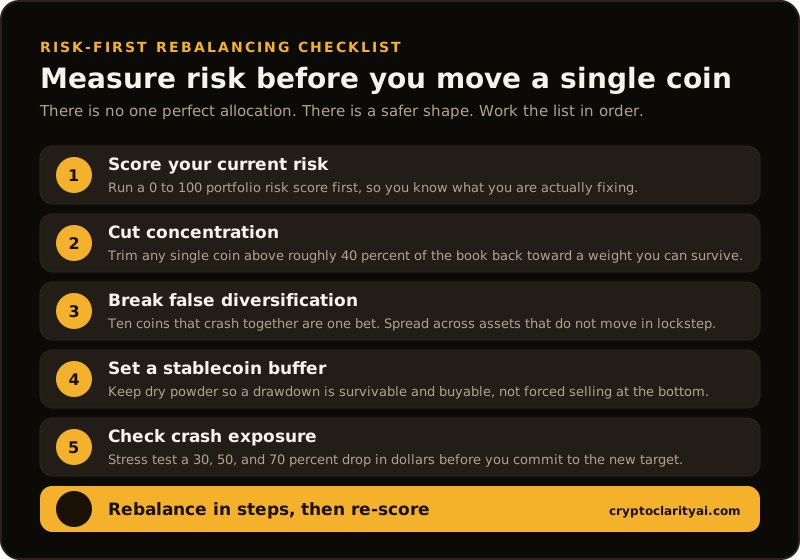
A sound crypto rebalancing strategy for 2026 starts with one shift in thinking: rebalance to control risk, not to chase a perfect allocation. The goal is a portfolio shape you can survive through a bad quarter, not a set of weights that look tidy on a spreadsheet. Everything below is about building that shape, so a single drawdown dents you instead of wrecking you.
This is the strategy piece, the why. If you want the click-by-click mechanics, see how to rebalance a crypto portfolio. Here we stay on the thinking that should guide every trade.
Lead with risk, not the calendar
Most rebalancing advice starts with a schedule: rebalance every quarter, every month, on your birthday. A calendar is easy to follow, but it is blind to what actually matters. If a coin doubles in week two of a quarter and turns your portfolio into a concentrated bet, a calendar rule leaves it dangerous for ten more weeks before you act.
Risk-first flips the order. You decide what a survivable portfolio looks like, then rebalance whenever the book drifts out of that safe zone. The calendar becomes a backstop, not the trigger. There is no single correct allocation to aim for, only a structure that stays inside limits you can live with.
Threshold-based beats guessing
The cleanest way to make risk-first concrete is a threshold, sometimes called a drift band. You set a rule such as, trim any single position that grows past 40 percent of the total, and act when the rule fires rather than on a date.
Suppose your target for a core holding was 25 percent. A calendar-only holder waits for the next quarter no matter what. A threshold holder sets a band, say plus or minus 10 points, and rebalances only when the position crosses 35 percent or drops under 15 percent. This does two things at once. It cuts pointless trades when nothing has moved much, which saves fees and taxable events, and it forces action exactly when a position has become a problem. A practical 2026 setup is a light quarterly check combined with a hard drift trigger, so slow drift and sudden pumps are both covered.
Set concentration caps you will actually enforce
The most important number in your strategy is your concentration cap. Nobody decides to put half their money in one coin. It happens because that coin ran, and they never trimmed. A cap turns that drift into a decision.
A common ceiling is roughly 40 percent in any one asset, above which you trim back toward your target. The exact figure is a judgment call, and it should not be the same for every asset. A large-cap you understand can carry a higher ceiling than a small-cap or a meme position, which deserves a much tighter cap because it is the most fragile thing you hold. If you are unsure where your line sits, our concentration risk guide walks through how a single dominant position quietly becomes the whole story.
Break false diversification
A cap on one coin is not enough if all your coins move together. Owning eight altcoins is not diversification if every one of them is high-beta and they crash in the same hour. That is false diversification, and it is one of the sneakiest risks heading into 2026.
The fix is to group by behavior, not by ticker count. Sort your holdings into large-cap, mid-cap alts, small-cap or speculative, and stablecoins. If 70 percent of the book sits in one correlated bucket, you are concentrated even though the screen shows a long, comforting list of names. A real rebalancing strategy trims the crowded bucket, not just the single biggest coin.
Keep a stablecoin buffer
A stablecoin buffer is the part of the strategy that pays off when everything else falls. Holding a slice in stablecoins does two jobs. It lowers your total drawdown in a crash, and it gives you dry powder to rebalance into weakness instead of selling at the bottom. Suppose you keep 15 percent in stablecoins. When the market drops 40 percent, that buffer is what lets you top up the positions you believe in at lower prices, calmly, on your own terms.
Worked example: a book that drifted to 70 percent SOL
Say you started 2025 with a balanced $40,000 book: 40 percent BTC ($16,000), 30 percent ETH ($12,000), 15 percent SOL ($6,000), and 15 percent stablecoins ($6,000). SOL then ran hard. A year later the total is $70,000, and SOL alone is now worth roughly $49,000, about 70 percent of everything. On paper it feels great. Structurally it is a single-coin bet wearing a portfolio costume.
A risk-first strategy does not ask, what is the perfect allocation. It asks, what breaks the danger. First, the 40 percent cap fires, so SOL gets trimmed back toward target, freeing tens of thousands of dollars. That is not a call on where SOL goes next, it is a rule about how much of your future you want riding on one asset. Second, the proceeds rebuild the buckets that thinned out, restoring the BTC and ETH core so the book is no longer one chart away from a bad month. Third, the stablecoin buffer is topped back to around 15 percent, roughly $10,500, so you have cash ready for the next dip. The portfolio is still yours, still crypto-heavy, just no longer betting the house on one line.
This is educational information about portfolio structure, not financial advice.
Re-score after every move
The final habit is the one most people skip: check the result. Rebalancing changes your risk, so you want to see the new shape, not assume it. Run your holdings through a crypto portfolio health score after each set of trades and confirm concentration and correlation actually came down. Before you trade, a rebalancing calculator shows the exact drift and the moves to close it, and a dedicated rebalancing tool can rank those moves by risk impact.
You can do all of this free, with no signup and no wallet connection, in the live demo. Type your holdings, see your drift, and get a 0 to 100 score with a plain-language label. If it comes back healthy, you are done. If it comes back concentrated, the $19 $12 lifetime unlock lays out the exact fix-it plan, and you can re-run it any time your holdings change.
The takeaway
A crypto rebalancing strategy for 2026 is not about finding the one right allocation. It is about caps you enforce, thresholds that trigger action, buckets that are genuinely different, a buffer that softens crashes, and a re-score that proves it worked. Build the survivable shape first, and the numbers take care of themselves.
Frequently asked questions
- What is a risk-first crypto rebalancing strategy?
- It means you rebalance to control danger, not to chase a perfect allocation. Instead of only asking whether weights match a target, you trim positions that have grown into oversized bets, break up coins that all crash together, and keep a stablecoin buffer. The goal is a portfolio shape you can survive.
- Should I rebalance on a calendar or on thresholds?
- Thresholds usually beat a fixed calendar. A calendar rule can leave a runaway position dangerous for months, while a threshold rule acts when any coin drifts past a set band, for example 40 percent of the book. A quarterly check plus a drift trigger together works well for most long-term holders.
- How much should one coin be capped at?
- There is no single correct number, only a safer structure. Many long-term holders treat roughly 40 percent in any one coin as a ceiling that forces a trim. The right cap depends on which asset it is, since a large-cap ceiling and a meme-coin ceiling should not be the same.
- Is rebalancing free to check with Crypto Clarity AI?
- Yes. You enter your holdings manually with no wallet connection, and the free demo shows your drift and headline risk read. A one-time 19 dollar unlock opens the full breakdown and fix-it plan for lifetime access, and you can re-run it any time your holdings change.
See where your portfolio has drifted and run your risk score free before you rebalance.
Free portfolio health score across 12 dimensions. No signup. Real fund-style math on your holdings.
