Crypto Portfolio Rebalancing Tool: What Good Ones Show (2026)
By the founder · Published 2026-07-05
A good crypto portfolio rebalancing tool shows the risk impact of a change before you trade. See what to look for, what to avoid, and check yours free, no wallet connection.
A crypto portfolio rebalancing tool should do one thing that most of them do not: show you whether the change you are about to make actually leaves you safer, before you place a single trade. Most "rebalancing tools" are just balance trackers with a pie chart. They tell you your current split and a target split, then leave you to guess whether shuffling those slices helped or hurt.
The tools worth using answer a harder question. Not "what do I own?" but "does this new shape score better on risk, and what does it cost me if the market falls?" This guide covers exactly what a good tool should surface before you trade, and the one thing to walk away from.
The four things a real rebalancing tool shows before you trade
A pie chart is a picture of the past. Rebalancing is a decision about the future, so the tool has to show the consequences of the move, not just the move itself. Four outputs separate a real rebalancing tool from a pretty tracker.
1. The risk impact of the change. Before and after. If you trim a coin from 45 percent down to 25 percent, does your overall risk score actually improve, or did the money just move into something equally fragile? A tool that scores both the current portfolio and the proposed one lets you see the delta instead of hoping. This is the whole point, and it is the feature most tools skip.
2. Concentration and correlation of the target. A new allocation can look tidy and still be one bet in disguise. Suppose you rebalance out of a single large-cap into five mid-cap alts that all move together. Your biggest-position number drops, so the pie looks calmer, but your real exposure barely changed because those five fall as a block. A good tool measures the correlation of the target, not just the count of coins. (More on that trap in our crypto concentration risk guide.)
3. The exact dollar amounts to trim and add. Percentages are easy to nod along to and hard to act on. "Reduce SOL by 15 points" means nothing at the exchange. "Sell about $3,000 of SOL and add about $1,800 to your stablecoin buffer" is a plan you can execute. The tool should translate the target into specific buy and sell figures for your actual book.
4. The crash exposure of the proposed target. The new shape needs a stress test too. Suppose your rebalanced portfolio is worth $40,000 with $34,000 in non-stablecoins. A 30 percent drop is down $10,200, a 50 percent drop is down $17,000, and a 70 percent drop is down $23,800. If those numbers on the target are still more than you can stomach, the rebalance did not go far enough, and better to learn that now than after you trade.
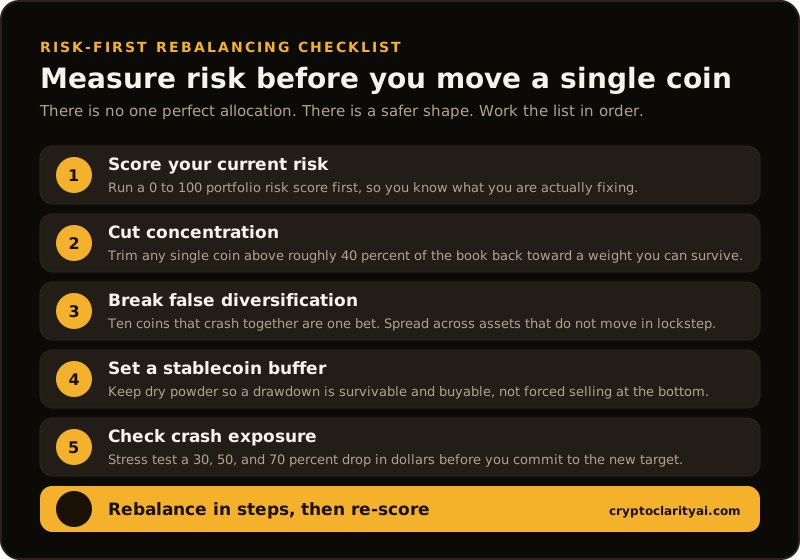
A worked example: two rebalances that look identical on a pie chart
Say your portfolio is $50,000 and one coin has run to 50 percent of it, $25,000. Both plans below cut that position to 25 percent. On a pie chart they look the same. On risk they are worlds apart.
Plan A moves the $12,500 you trim into three high-beta alts you already hold. Your top position drops, but those alts are tightly correlated with the coin you just trimmed, so in a sell-off the whole group still falls together. A tool that scores this shows the risk score barely moving, because concentration went down while correlation stayed high.
Plan B moves $7,500 into a large-cap you do not already hold and $5,000 into a stablecoin buffer. Now the trimmed money sits in assets that do not all move in lockstep, and you have dry powder. A tool that scores this shows a real improvement, and the crash-exposure numbers on the target come down meaningfully.
Same pie chart, different outcome. Without a tool that scores the before and after, you would have no way to tell Plan A from Plan B until the next drawdown taught you the hard way. This is educational information about portfolio structure, not financial advice.
The one thing to avoid: "connect your wallet to auto-rebalance"
Here is the bright line. A rebalancing tool never needs to touch your wallet to show you what to do. Any product that asks you to connect a wallet, hand over a seed phrase, or paste an exchange API key so it can "auto-rebalance" for you is asking for a level of access that a planning tool simply does not require. You can compute drift, target weights, dollar trades, and risk impact from numbers you type in by hand. If a tool insists on connecting, close the tab.
Enter your holdings manually, get the plan, and place the trades yourself on your own exchange. That keeps the keys where they belong and still gives you every number you need.
How to actually use one, start to finish
Work it in order, and let the tool do the measuring at each step.
First, score where you are now with a crypto portfolio risk calculator so you know the number you are trying to beat. Then compute the trades with a crypto portfolio rebalancing calculator, which turns your current holdings and target into the exact trim-and-add dollar amounts. Finally, confirm the new shape actually scores safer by re-running the full crypto portfolio health score on the proposed allocation and checking its crash exposure before you commit.
For the mechanics of placing the trades, our step-by-step guide to rebalancing a crypto portfolio walks through timing and bands. For the bigger picture of how often and why, see our rebalancing strategy for 2026. This article is the buyer's-eye view: what a tool should show you so you can trust the move.
The bottom line
A pie chart tells you what you have. A rebalancing tool worth its name tells you whether your next move makes you safer, in a score you can see and dollars you can act on, and it does it without ever touching your wallet. Score the current portfolio, compute the exact trades, then confirm the target scores better and its crash numbers are survivable.
You can run that full 12-dimension score on any allocation, current or proposed, free and with no wallet connection, in our live demo. Type your holdings, see your risk, then test the shape you are thinking about before you trade. If it comes back exposed, the $19 $12 lifetime unlock opens the prioritized fix-it plan and the full breakdown so you can rebalance with numbers instead of guesses, and re-run it any time your holdings change.
Frequently asked questions
- What should a crypto portfolio rebalancing tool show me?
- More than a pie chart. A good one shows the risk impact of the change before you trade, the concentration and correlation of the target allocation, the exact dollar amounts to trim or add, and the crash exposure of the proposed shape. If it only shows current versus target percentages, it is a tracker, not a rebalancing tool.
- Should a rebalancing tool connect to my wallet?
- No. Anything asking to connect a wallet to auto-rebalance is a risk you do not need to take. A safe tool lets you enter holdings and targets by hand, with no wallet connect, no seed phrase, and no exchange API key. Crypto Clarity AI is free to try and unlocks the full breakdown for a one-time 19 dollars, not a subscription.
- Does rebalancing actually reduce risk?
- It can, but only if the new shape is genuinely safer. Trimming an oversized coin lowers concentration, and moving out of correlated bets lowers the odds that everything falls together. A tool that scores the before and after tells you whether a given rebalance helped or just reshuffled the same risk.
- How is this different from a rebalancing calculator?
- The calculator computes drift and the trades to fix it. This article explains what a rebalancing tool should surface so you can judge a change before committing. Run the calculator for the numbers, then confirm the new shape scores safer with a full risk score.
See whether your proposed new allocation actually scores safer, free and with no wallet connection.
Free portfolio health score across 12 dimensions. No signup. Real fund-style math on your holdings.
