Crypto Portfolio Crash Test: What a 30%, 50%, or 70% Drop Does to You
By the founder · Published 2026-07-05
Run a crypto portfolio crash test in minutes. See what a 30%, 50%, or 70% drop does to your real holdings in dollars, free and with no wallet connection.
A crypto portfolio crash test answers one blunt question: if the market falls 30, 50, or 70 percent, how many dollars are you left with? Not a mood, not a guess, a number. You apply each drop to your real holdings and read the result. In about a minute you go from "a crash would hurt" to "a 50 percent drop turns my $80,000 into $40,000, and the meme sleeve is doing most of the damage."
That shift, from a feeling to a figure, is the entire point. Most people never run the test, so a crash arrives as a surprise instead of a scenario they already priced in.
Why "down 50 percent" is a number, not a headline
During the 2018 bear market, plenty of portfolios lost 80 percent or more from their highs. Individual coins did worse. So when someone says a 50 percent drop is unlikely, the history disagrees. A 50 percent fall is an ordinary event inside a normal crypto cycle, and a 70 percent fall has happened more than once.
A crash test takes those percentages seriously and runs them against your book today. The result is uncomfortable on purpose. Seeing "$100,000 becomes $30,000 at down 70 percent" is exactly the information you want before it happens, not after.
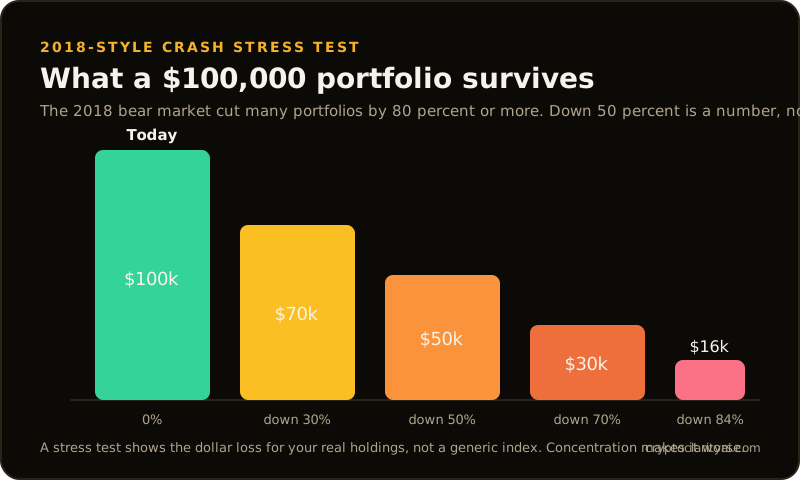
A worked example
Suppose you hold $100,000 split like this: $52,000 in BTC, $18,000 in ETH, $16,000 in SOL, $9,000 in a spread of smaller alts, and $5,000 in stablecoins. Now apply three drops. To keep it readable, say the crypto positions all fall by the scenario amount and the stablecoins hold their value.
At a 30 percent drop, the $95,000 of crypto becomes about $66,500, so with the stables you are near $71,500. At a 50 percent drop, the crypto is worth about $47,500, leaving roughly $52,500. At a 70 percent drop, the crypto is around $28,500, so you are close to $33,500. The $5,000 buffer barely moves the needle here, which is itself a finding: this book has very little dry powder.
Two things stand out. First, the losses are large even for a fairly BTC-heavy portfolio. Second, the smaller alts and SOL, which are more likely to fall harder than BTC in a real crash, would pull the true numbers lower than this even split suggests. A generic index cannot tell you that. A crash test on your specific holdings can.
Concentration is the multiplier
The single biggest factor in how badly a crash hits you is concentration. If one coin is 60 or 70 percent of the book, its crash is your crash. Diversification across assets that do not all move together is what softens the blow, and a lot of portfolios only look diversified. Ten alts that pump and dump on the same sentiment behave like one position when the market turns.
That is why a crash test pairs naturally with a concentration check. If the crash number frightens you, the fix usually starts with trimming the largest position and breaking up false diversification. You can pressure-test that idea on the concentration calculator and see the risk score move before you touch anything real.
The stablecoin buffer changes the story
Look again at the example. A $5,000 buffer on a $100,000 book is about 5 percent, and it does almost nothing to cushion a 50 percent fall. Compare that to a portfolio holding 20 percent in stables. The same market drop leaves far more standing, and just as important, it leaves cash to buy the dip instead of forcing a sale at the bottom.
A buffer is not about predicting the crash. It is about being able to survive one and act during it. When you run your own crash test, watch what happens to the final number as you vary the stablecoin slice. It is often the cheapest risk reduction available.
Turning the test into a plan
A crash test is only useful if it changes something. Once you have your three numbers, ask a simple question: is the down 50 percent figure a number you could live with, or one that would force a panic decision? If it is the second, you have found your real risk tolerance, and it is lower than the balance made you feel.
From there the moves are ordinary. Trim any single coin that dominates the book. Spread into assets that do not crash in lockstep. Raise the buffer to a level that lets a bad month be survivable and buyable. Then run the crash test again and confirm the down 50 percent number actually improved. This is educational information about portfolio structure, not financial advice, so size every change to your own situation.
If you would rather not do the arithmetic by hand across every scenario, the crypto stress test and the portfolio risk calculator run the drops for you and fold them into a single 0 to 100 score. You can start with the free demo, enter your holdings without connecting a wallet, and see the crash figures in about a minute. The full breakdown, every flag, and a fix-it plan are a one-time $12 launch price (regularly $19) for lifetime access.
The takeaway
A green portfolio number tells you what you own. A crash test tells you what you could keep. The market does not ask permission before a 30, 50, or 70 percent move, so the honest thing is to run those numbers now, while it is a calm exercise rather than a live emergency. Measure the drop in dollars, find the concentration doing the damage, and give yourself a buffer. The goal is not to predict the next crash. It is to already know you can survive it.
Frequently asked questions
- What is a crypto portfolio crash test?
- It is a simple exercise where you apply a set of drops, usually 30, 50, and 70 percent, to your actual holdings and read the result in dollars. Instead of a vague feeling that a crash would hurt, you see the specific number you would be left with, which makes the risk concrete.
- How big can a crypto crash realistically be?
- Major coins have fallen 50 percent or more inside a single cycle, and the 2018 bear market cut many portfolios by 80 percent or more from their highs. Smaller and more concentrated books tend to fall harder, so a 70 percent scenario is not extreme, it is prudent planning.
- Do I need to connect a wallet to run a crash test?
- No. You enter each asset and its dollar value by hand. There is no wallet connection, no seed phrase, and no API key. A free score shows your headline result, and a one-time 19 dollars unlocks the full breakdown for life.
See what a real crash would do to your portfolio in about 60 seconds.
Free portfolio health score across 12 dimensions. No signup. Real fund-style math on your holdings.
