Do You Have Too Much Solana in Your Portfolio? (2026)
By the founder · Published 2026-07-05
Wondering if you hold too much Solana in your portfolio? Here is how to check SOL allocation risk by concentration, correlation, and crash exposure. Free, no wallet connection.
If a single coin is more than roughly 40 percent of your holdings, you have too much of it, and for a lot of people right now that coin is SOL. The problem is almost never Solana itself, which is a legitimate large cap. The problem is size and correlation: an oversized SOL position turns your whole portfolio into one bet that rises and falls together. This guide shows you how to tell if you are in that spot, without guessing, and what a survivable weight looks like.
The short answer
Solana is fine to hold. The question is how much, and next to what. A position that dominates your portfolio decides your outcome no matter how many other tickers you own. So the honest test is not "do I like SOL," it is "if SOL had a rough month, how much of my money moves with it?" If the answer is "most of it," your allocation, not the asset, is the risk.
The concentration threshold nobody wants to hear
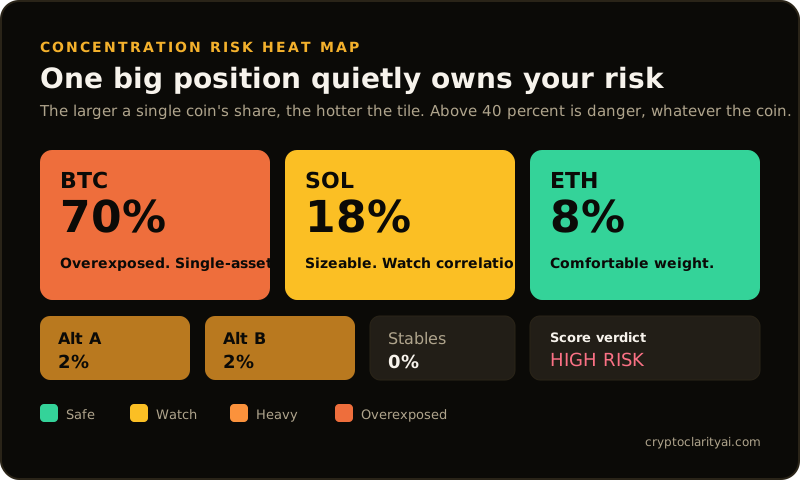
Here is the rule of thumb that decides most crypto portfolios: once any one asset crosses about 40 percent of your total, that single position dominates your risk. Above that line, your diversification barely matters, because one coin is steering the ship.
Suppose your book is $50,000 and SOL is $30,000 of it. That is 60 percent in one asset. Everything else, your BTC, your stablecoins, your handful of alts, is along for the ride. When SOL moves 20 percent, your whole portfolio moves roughly 12 percent from that one holding alone. You do not have a diversified portfolio with some SOL in it. You have a SOL bet with some garnish. You can measure your own single largest weight in the crypto portfolio concentration calculator.
Why "SOL plus alts" is less diversified than it looks
The common defense is, "I am not all-in SOL, I also hold other alts." That feels safer, but it usually is not, because SOL is tightly correlated with the rest of the alt layer-1 basket. When one alt L1 sells off, they tend to sell off together. Owning SOL, plus a couple of competing layer-1s, plus a few of the same-cycle tokens is closer to owning one position three times than owning three independent positions.
Say you hold 45 percent SOL and 25 percent split across three other alt L1s. On paper that reads as four positions and one core. In practice, because those four move together, your effective number of independent bets is closer to one or two. A single alt L1 drawdown can hit 70 percent of your book at once. That is the trap: a longer list of tickers hides the fact that they share the same fate. The same pattern shows up across most altcoin-heavy books, which we break down in altcoin portfolio risk.
SOL's drawdown history is a reason to size it on purpose
Solana has delivered real upside, but it has also had brutal drawdowns, including a well-documented fall of more than 90 percent from its 2021 peak during the 2022 bear market. That is not a knock on the project; big-swinging large caps do this. It is a reason to choose your position size deliberately instead of letting a good run inflate it for you.
That last part is what catches people. You do not usually decide to be 60 percent SOL. You buy a reasonable slice, it outruns everything else, and one day it is most of your portfolio because you never trimmed. A position that grew into concentration is still concentration. The heat map does not care how you got there.
Liquidity: the risk that shows up only when you sell
Concentration and correlation decide how far you fall. Liquidity decides whether you can actually get out at the number you see on screen. SOL is liquid enough at normal size, but a very large position in a fast selloff can still cost you on the way out, and any thinner alts sitting next to it are far worse. A paper loss becomes a real loss the moment the exit is crowded. Sizing SOL so you could trim it calmly, rather than dumping it in a panic, is part of managing the position.
Worked example: trimming SOL from 60 percent to a survivable weight
Take the $50,000 book with $30,000 in SOL again, 60 percent. Now model a 50 percent SOL drawdown, which is well inside its historical range.
- Before trimming (60 percent SOL): a 50 percent SOL drop wipes out $15,000. That is a 30 percent hit to the entire portfolio from one asset, before anything else even moves.
- After trimming to 25 percent SOL: you move $17,500 out of SOL, leaving $12,500 in it. Say you put $10,000 into BTC and $7,500 into stablecoins as a buffer. Now the same 50 percent SOL drop costs $6,250, a 12.5 percent hit to the book instead of 30 percent.
Same asset, same crash, less than half the damage, purely from size. You did not predict anything or time anything. You just stopped letting one coin decide your year. To see how a move like that plays across 30, 50, and 70 percent scenarios at once, run a crypto stress test. This is educational information about portfolio structure, not financial advice.
How to check your own SOL allocation without guessing
You can do a rough version by hand: add your SOL value, divide by your total, and if it is over 40 percent, concentration is your dominant risk. Then group SOL with your other alt L1s and check whether that correlated bucket is most of your book. Finally, write the dollar loss, not the percentage, for a 50 percent SOL drop, because "down $15,000" lands harder than "down 50 percent" and tells you if you can stomach it.
Doing it by hand is tedious and easy to fudge in your own favor. The faster path is to type your holdings into the free Crypto Clarity AI demo and get a 0 to 100 score across all 12 risk dimensions in about a minute. You enter everything manually, so there is no wallet connection, no exchange login, no seed phrase, and no API key. The free score tells you whether SOL is your dominant risk; if you want the full correlation map, every per-position flag, and the exact rebalancing dollar amounts to bring SOL to a survivable weight, the one-time $12 launch price (regularly $19) unlock opens all of it for lifetime access, and you can re-run it any time your holdings change.
The takeaway
Too much Solana is a size problem, not a Solana problem. Above roughly 40 percent, one coin dominates your risk; SOL's tight correlation with other alt L1s means "SOL plus alts" is often one bet wearing a costume; and its drawdown history is a reason to pick your weight on purpose. Check your concentration, model a real crash in dollars, and trim to a weight you could hold through a bad month. Do it before the next dip, not after.
Frequently asked questions
- How much Solana is too much in a portfolio?
- There is no single correct number, but once one coin passes roughly 40 percent of your total, that position dominates your risk. At 60 percent SOL, your portfolio moves almost entirely with one asset. The tool shows your exact SOL weight and how much of your crash exposure it drives.
- Is Solana riskier than Bitcoin?
- Historically SOL has deeper drawdowns and thinner liquidity than Bitcoin, and it moves closely with other layer-1 alts. It is a legitimate large cap, but it swings harder, so the same dollar amount carries more risk than in BTC.
- Does holding SOL plus other alts count as diversification?
- Usually less than it looks. SOL is highly correlated with other alt layer-1s, so a SOL plus alts book often behaves like one bet. The tool measures your effective number of independent positions after correlation.
- How do I check my Solana allocation risk for free?
- Enter your holdings in the demo and get a free 0 to 100 risk score across 12 dimensions in about a minute, with no wallet connection or signup. The full breakdown and fix-it plan unlock with a one-time 19 dollars for lifetime access.
See exactly how much of your crash risk is riding on SOL, free and in about a minute.
Free portfolio health score across 12 dimensions. No signup. Real fund-style math on your holdings.
